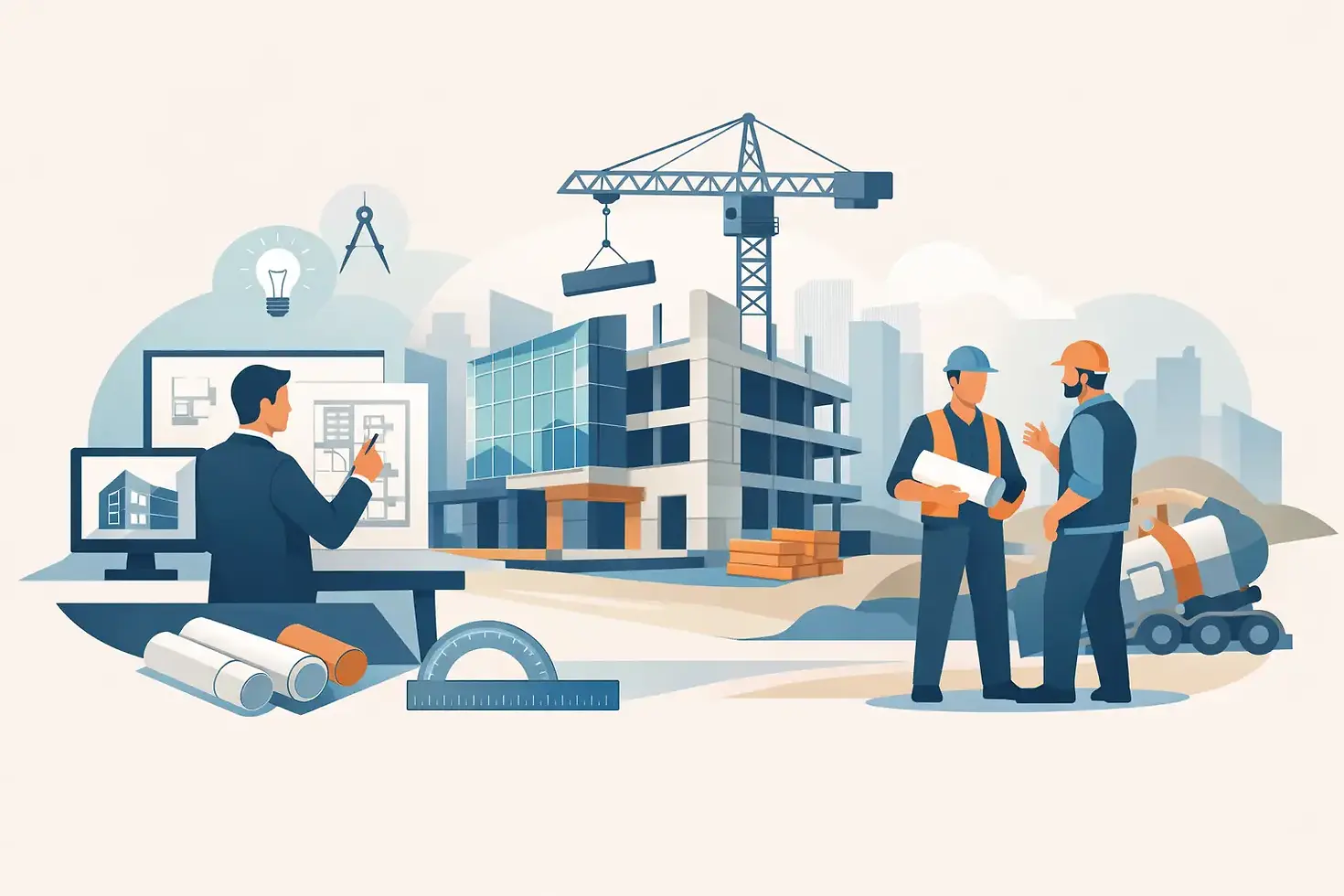
A project can look efficient on paper and still lose time, money, and performance the moment design decisions meet field conditions. That gap is exactly why integrated architectural and construction services matter.
For commercial developers, business owners, and residential clients planning substantial new construction, the issue is not simply convenience. It is accountability. Separate designers, consultants, and builders can each do strong work in isolation, but disconnected delivery often creates avoidable friction - scope gaps, conflicting details, delayed decisions, and buildings that underperform in real operating conditions. An integrated model is built to reduce those risks at the source.
What Integrated Services Really Mean
At its best, an integrated approach brings architectural design, construction execution, and project management into a single delivery framework. That means the people shaping the building's form, performance strategy, constructability, and budget are aligned from the beginning rather than trying to reconcile competing priorities later.
This matters because buildings are systems, not separate parts. The exterior envelope affects HVAC loads. Structural choices affect usable space and cost. Mechanical design affects comfort, energy use, and maintenance demands for years after turnover. If those decisions are made in silos, owners often pay for that fragmentation more than once.
An integrated team evaluates trade-offs early. A higher-performing wall assembly may raise initial cost but reduce energy demand, improve moisture control, and extend service life. A mechanical system may be right-sized more accurately when envelope performance is modeled correctly from the outset. These are not abstract technical wins. They shape operating costs, occupant comfort, and capital planning over the life of the asset.
Why Owners Choose an Integrated Model
The strongest reason is simple: one accountable partner. When design intent and construction execution are handled under the same leadership structure, decisions move faster and responsibility stays clear.
That clarity changes the owner's experience. Instead of managing handoffs between architect, engineer, estimator, and contractor, the owner works with one team that can evaluate design implications in real time. Budget conversations are grounded in current construction realities. Material selections are reviewed not only for appearance, but also for durability, installation quality, and long-term performance. Schedule impacts can be addressed before they become claims or change orders.
This does not mean every project becomes easier. Complex sites, permitting requirements, supply chain issues, and evolving owner goals still require disciplined management. But integrated delivery gives those challenges a better operating environment. Coordination is built in rather than patched together.

Integrated Services Improve Building Performance
For clients focused on high-performance buildings, integration is especially valuable. Energy efficiency is not achieved by one product or one consultant. It comes from coordinated decisions across envelope design, air sealing, insulation strategy, glazing, mechanical systems, controls, and construction quality.
A building may have premium equipment and still waste energy if the enclosure leaks air or if thermal details are poorly executed in the field. On the other hand, a well-designed envelope can reduce mechanical demand and support more stable indoor conditions with less strain on the system. That is the advantage of integrated planning - the building is treated as a performance asset, not a collection of disconnected scopes.
This approach also supports durability. Moisture management, thermal continuity, commissioning, and detailing around penetrations are rarely glamorous topics, but they are central to long-term building health. Owners investing in commercial facilities or custom residences need more than a finished structure. They need a building that holds up under real use, regional climate conditions, and years of operation.
Key Advantages of Integration
- One accountable partner for design, engineering, and construction
- Budget decisions grounded in real construction costs from day one
- Performance goals protected through coordinated envelope and mechanical design
- Reduced change orders, RFIs, and scope gaps
- Faster decision-making with no handoff friction between teams
- Lifecycle value over first-cost reduction
Where Fragmentation Usually Costs the Most
The biggest losses are often hidden during early project stages. A design may advance without accurate cost feedback. Construction teams may inherit details that are difficult to build as drawn. Mechanical systems may be selected before enclosure performance is fully resolved. Each issue seems manageable on its own, but together they create schedule drag and budget pressure.
Value engineering is another common pain point. In a fragmented model, it often happens late and under stress. Materials change after design is complete. Assemblies are simplified without full performance review. Owners are forced to choose between budget and intent because the project was not aligned early enough. An integrated team can still make value-based adjustments, but the process is more strategic. Decisions happen earlier, when revision costs are lower and performance goals can still be protected.
What to Evaluate Before Hiring a Design-Build Partner
Not every firm offering integrated delivery operates at the same level. Owners should look past the label and evaluate how the team actually manages design, construction, and technical performance.
Experience matters, especially in projects where building envelope quality, mechanical coordination, and energy outcomes are priorities. A qualified partner should be able to explain how design decisions affect constructability, how field execution protects performance intent, and how project management keeps scope, schedule, and quality aligned.
It also helps to ask practical questions: How is cost informed during design? Who is responsible for performance coordination across disciplines? How are envelope and mechanical strategies reviewed together? What quality control processes are used during construction? Strong answers usually reflect a team that has built integrated systems into its operating model, not just its marketing.
For owners in Texas and Oklahoma, regional knowledge adds another layer of value. Climate, code requirements, material behavior, and local construction conditions all influence how a project should be designed and built. High heat, humidity shifts, storm exposure, and long-term energy demands are not secondary concerns. They should shape project strategy from day one.
When Integrated Delivery Is the Right Fit
This model is particularly effective for owners who want speed, accountability, and measurable performance outcomes. Commercial projects with tight operating requirements benefit because design and construction decisions can be made with a clearer view of schedule and systems coordination. Developers benefit from reduced friction and stronger budget alignment. Homeowners pursuing custom, quality-driven construction benefit from a more disciplined path from concept to completion.
That said, integrated delivery is not just for highly complex buildings. It is also the right fit for clients who simply do not want preventable disconnects between what is drawn, what is priced, and what gets built. The best results come when owners are clear about priorities early. If energy performance, durability, lifecycle value, and technical precision matter, those goals should shape the delivery model from the beginning.
A Higher Standard for Project Leadership
Integrated architectural and construction services are ultimately about more than consolidation. They create a framework for better decisions. Better decisions at concept stage. Better coordination during design. Better execution in the field. Better performance after occupancy.
That is why this model continues to gain ground among owners who think beyond immediate turnover. They are not only building for occupancy dates or ribbon cuttings. They are building assets that need to perform, endure, and support long-term value.
For clients seeking that level of control and technical confidence, Visionary Building Services LLC reflects what integrated delivery should look like - architectural precision, construction mastery, and a clear commitment to high-performance outcomes under one accountable structure. From the first sketch to the final handshake, we provide a full suite of building solutions centered on high performance.
"The smartest projects are rarely defined by how many parties are involved. They are defined by how well the right expertise is unified around the result."
Serving Burkburnett, Wichita County, and communities across Texas and Oklahoma.
940-434-2129