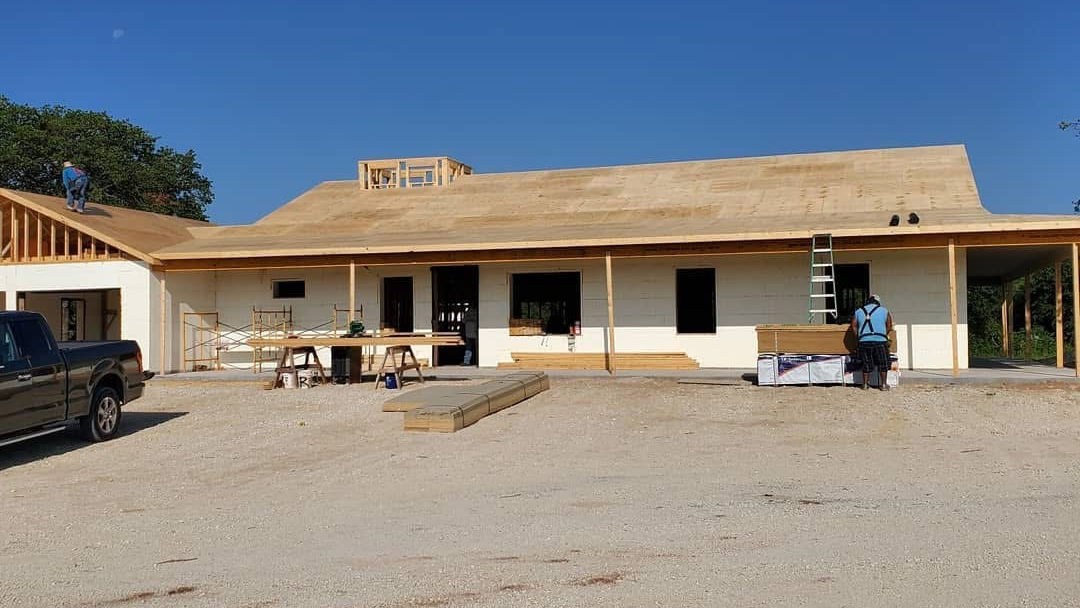
Most owners making decisions about wall systems focus on cost per square foot. That is a reasonable starting point, but it rarely tells the full story. Insulated concrete form construction - ICF - tends to cost more upfront than wood frame. It also tends to outperform wood frame in nearly every category that matters over the life of the building.
Understanding what ICF is, how it works, and what it delivers is the foundation for making an informed decision. This article covers the basics every owner should know before choosing a wall system for a residential or commercial project.
What ICF Actually Is
ICF stands for insulated concrete forms. The system uses interlocking foam blocks - typically expanded polystyrene - stacked to form the shape of a wall. Steel reinforcement is placed inside the cavity, and concrete is poured to fill the form. Once cured, the foam stays in place permanently on both sides of the concrete core.
The result is a composite wall with a reinforced concrete structural core sandwiched between two continuous layers of rigid insulation. That assembly performs very differently from a wood stud wall with batt insulation in the cavities.
The exterior and interior surfaces of an ICF wall can be finished like any conventional wall. Stucco, brick, siding, drywall, and tile all work on ICF. From a finished appearance standpoint, an ICF building looks identical to any other well-built structure. The difference is entirely in what is inside the wall.
Thermal Performance That Wood Frame Cannot Match
The most immediate performance advantage of ICF is thermal resistance. A typical ICF wall assembly achieves an effective R-value in the range of R-22 to R-30 depending on the foam thickness. That alone is competitive with well-insulated wood frame construction. But the bigger advantage is thermal mass.
Concrete has the ability to absorb heat during the day and release it slowly as temperatures drop. This thermal mass effect moderates interior temperature swings without the HVAC system working harder. In a Texas climate with extreme summer heat, that matters. The building holds cooler temperatures longer during peak afternoon heat, reducing the load on mechanical systems during the hours when electricity is most expensive.
Wood frame walls do not offer thermal mass. They rely entirely on insulation R-value, which only slows heat transfer. ICF does both. That combination is why ICF buildings consistently show lower energy use than equivalent wood frame buildings even when the R-values on paper appear similar.
"ICF buildings consistently show lower energy use than equivalent wood frame buildings - even when R-values on paper appear similar."
Visionary Building Services LLC
Structural Strength and Disaster Resistance
A reinforced concrete wall is structurally different from wood frame in ways that matter in the real world. ICF walls are tested to withstand wind loads exceeding 200 mph. In tornado-prone areas of Texas and Oklahoma, that is not an abstract specification. It is the difference between a building that survives a severe storm and one that does not.
ICF also offers significantly better fire resistance than wood frame. Concrete does not burn. The foam insulation in most ICF systems has a fire rating, and the concrete core provides a substantial barrier that slows fire spread. For commercial occupancies, this can have implications for insurance, code compliance, and the ability to reduce fire suppression requirements in some jurisdictions.
For owners in the Texas and Oklahoma region, where hail, high winds, and severe weather are regular events, structural resilience is a legitimate factor in long-term building value. A building that withstands extreme weather without structural damage protects both the investment and the occupants.
Sound Insulation and Indoor Comfort
ICF walls provide substantially better sound insulation than wood frame. A typical ICF wall achieves a Sound Transmission Class (STC) rating in the range of 50 to 55. A standard wood frame wall with drywall on both sides typically achieves STC 36 to 44. The difference is noticeable in daily use.
For residential clients, this means a quieter home. Traffic noise, neighborhood sounds, and exterior disturbances are significantly reduced. For commercial clients, it can mean better acoustic separation between spaces, reduced mechanical noise transmission, and a more comfortable environment for occupants.
Sound insulation is one of the ICF benefits that owners often appreciate most after moving in, even if they did not specifically prioritize it during the design phase. It contributes to the overall quality of the interior environment in a way that is immediately perceptible.
Effective thermal resistance typical for ICF wall assemblies
Wind resistance rating for reinforced ICF wall systems
Sound transmission class for superior acoustic comfort
The Cost Question: Upfront vs. Lifecycle
ICF construction typically costs more per square foot than wood frame during initial construction. The premium varies based on project size, design complexity, local labor markets, and the specific ICF product specified. In most markets, the upfront premium is in the range of 3 to 10 percent of total construction cost.
That premium needs to be evaluated against what it buys. Lower energy bills over the life of the building. Reduced maintenance from a more durable exterior wall system. Potentially lower insurance premiums for improved fire and wind resistance. Better resilience against weather events that can cause costly repairs to wood frame structures.
For owners planning to occupy a building for 15 or more years, the lifecycle math often favors ICF. For developers focused on short-term resale, the calculus may be different. The right answer depends on the owner's priorities, timeline, and the specific project context. The important thing is to make the comparison with complete information rather than stopping at the initial cost number.
What ICF Requires from the Builder
ICF is not difficult to build with, but it requires a builder who understands the system. The forming process, concrete mix design, pour sequence, bracing requirements, and coordination with mechanical and electrical trades all differ from wood frame construction. A builder unfamiliar with ICF can make mistakes that are expensive to correct once the concrete is placed.
The mechanical and electrical rough-in in an ICF building requires planning. Conduit and boxes must be set before the pour. Chasing channels after the fact is possible but adds cost and disrupts the insulation continuity. A builder with ICF experience coordinates these trades early and manages the sequence correctly.
At Visionary Building Services LLC, our leadership brings specialty expertise in ICF construction developed over decades of high-performance project delivery. That experience matters when the wall system is the most important structural and thermal element in the building. Owners should ask any builder they are considering about their specific ICF experience, not just their general construction background.
Is ICF Right for Your Project?
ICF works well for a wide range of project types: custom homes, commercial offices, schools, healthcare facilities, and mixed-use buildings. It performs especially well in climates with significant temperature swings, high wind exposure, or where long-term energy cost reduction is a priority.
For projects in Texas and Oklahoma, where summer heat is intense and severe weather is common, the performance case for ICF is strong. The combination of thermal mass, high insulation value, and structural resilience addresses the real conditions these buildings face.
The best starting point is a direct conversation about your project goals, budget, and timeline. ICF is not the right answer for every situation, but for owners who want a building that performs better and lasts longer, it deserves serious consideration. Our team can help you evaluate whether it fits your specific project and what the real cost-benefit picture looks like for your circumstances.